YEAR
2026
CITY
MOSCOW
SERVICE
CREATIVE DIRECTION

THE BRIEF
The Moscow Transport Museum was conceived as a new-generation cultural institution dedicated to urban mobility, bringing together an exceptional collection of historic vehicles in one of Moscow’s most distinctive architectural landmarks. The ambition was to create a museum on the scale of the city’s transport system — one of the largest and most complex in the world, and a defining force in how Moscow has grown, lived and imagined its future over 150 years.
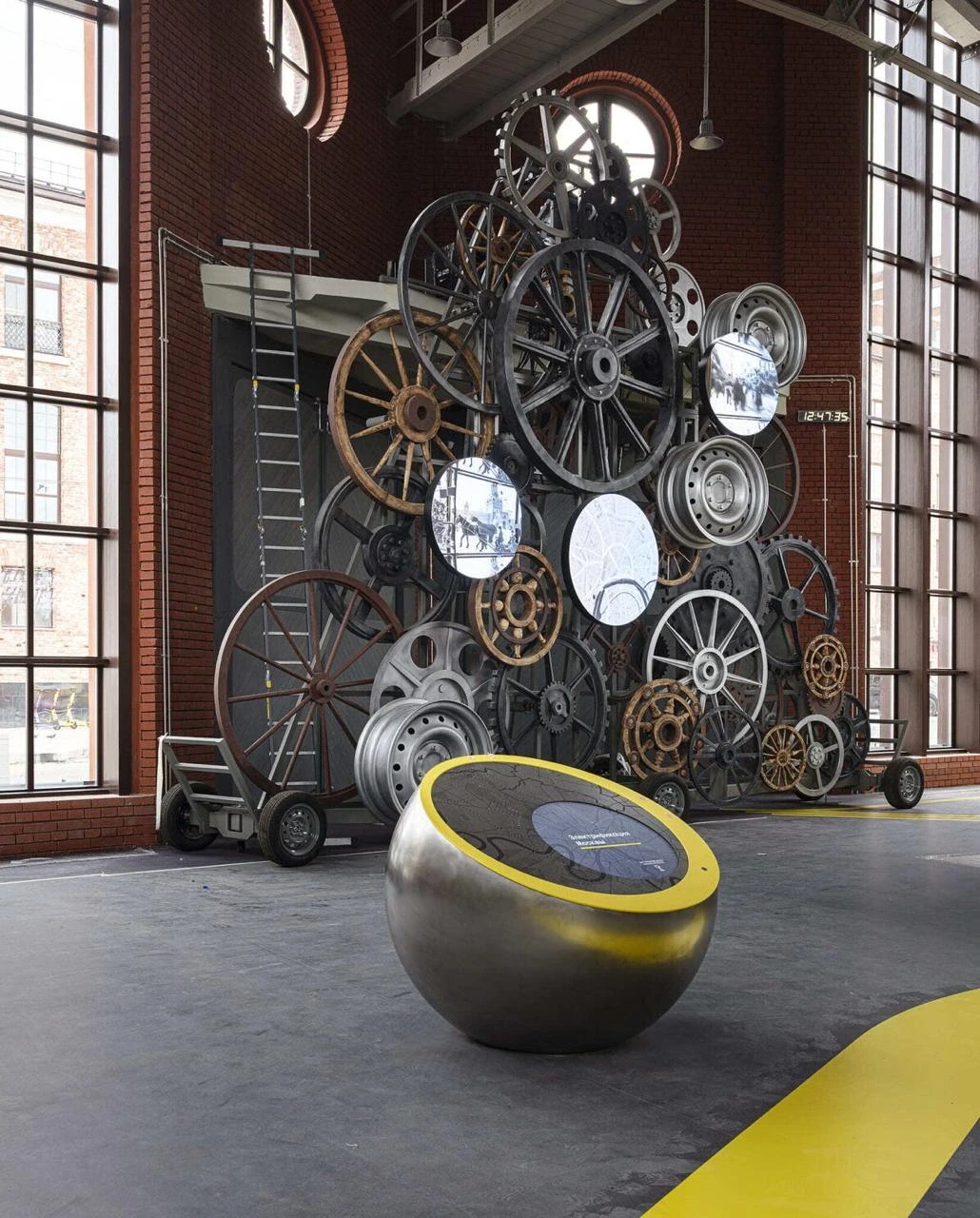
Its permanent home is the restored Melnikov Garage, a protected landmark of Russian Constructivism designed by Konstantin Melnikov in 1926 and the country’s first specialised truck garage. The remarkable column-free interior is spanned by a system of steel roof trusses attributed to Vladimir Shukhov, the pioneering Russian engineer often called the “Russian Eiffel”. Restoration returned the horseshoe-shaped building to its historic appearance, including its bevelled gables, brickwork, skylight and inclined ribbon roof glazing. A new underground level was constructed specifically for the Moscow Metro exhibition.
The ambition went far beyond a conventional transport museum. The challenge was to turn an extraordinary collection — including four vehicles that are the only surviving examples of their kind worldwide — into a living cultural destination for transport enthusiasts, families, children and anyone interested in the history, culture and future of the city.
Developed over 6 years, the project brought together architectural restoration, exhibition design, multimedia storytelling, interactive experiences and an ambitious cultural programming strategy. Its scale, architectural significance and collection place it alongside the world’s major transport museums.
Pitch bureau was commissioned to conceive, design and deliver the museum’s multimedia complex: the narrative, interactive and audiovisual experiences that would transform the remarkable collection and engineering heritage into a story about the city itself.
MY ROLE
I served as Co-Creative Director and head of the multidisciplinary creative team at Pitch, responsible for the concept, development and production of the museum’s multimedia exhibition complex throughout its development.
I joined at the initial research stage, well before the exhibition design and technical solutions were finalised. Together with the Museum’s director, the head of the Planet9 architectural team and Pitch’s Chief Technical Director, I visited leading European transport museums to study international best practices in exhibition design, interpretation, visitor engagement, technology and cultural programming. Having the project’s principal decision-makers travel together turned these visits into a working forum: we could compare approaches, make critical assessments, challenge assumptions and develop ideas collaboratively while the research was still in progress.
Over the following years, I led experience design and narrative development across two floors and 13 thematic zones. I oversaw the conceptualisation and production of multimedia and interactive content across a wide range of formats, from immersive audiovisual environments and interactive exhibits to transport simulators and digital interpretation systems. Many of the technological and interactive solutions were developed specifically for the museum in Pitch’s in-house R&D laboratory, enabling original approaches rather than reliance solely on existing frameworks and off-the-shelf technologies.
Working closely with curators, architects, engineers, designers and production teams, I shaped and directed the exhibition’s creative vision, integrating storytelling, spatial design, digital experiences and content production into a coherent visitor experience while balancing creative ambition with technical feasibility.
“Boris is as an outstanding creative director. He played a key role in shaping our museum, leading multimedia and content development from narrative to interactive solutions, and significantly enhancing the visitor experience.”
Oksana Bondarenko. Director, Moscow Transport Museum.
THE CHALLENGE
Transport museums tend to fall into one of two traps. Either they become halls of machinery that speak fluently to enthusiasts and barely at all to everyone else, or nostalgic displays that look backwards without connecting to contemporary life. Neither fully realises the potential of transport as a subject that touches almost everyone.
The project needed to communicate from multiple perspectives 150 years of urban transformation to audiences ranging from engineers and historians to families with young children, while accommodating an extensive collection and ambitious multimedia infrastructure within a protected architectural landmark.
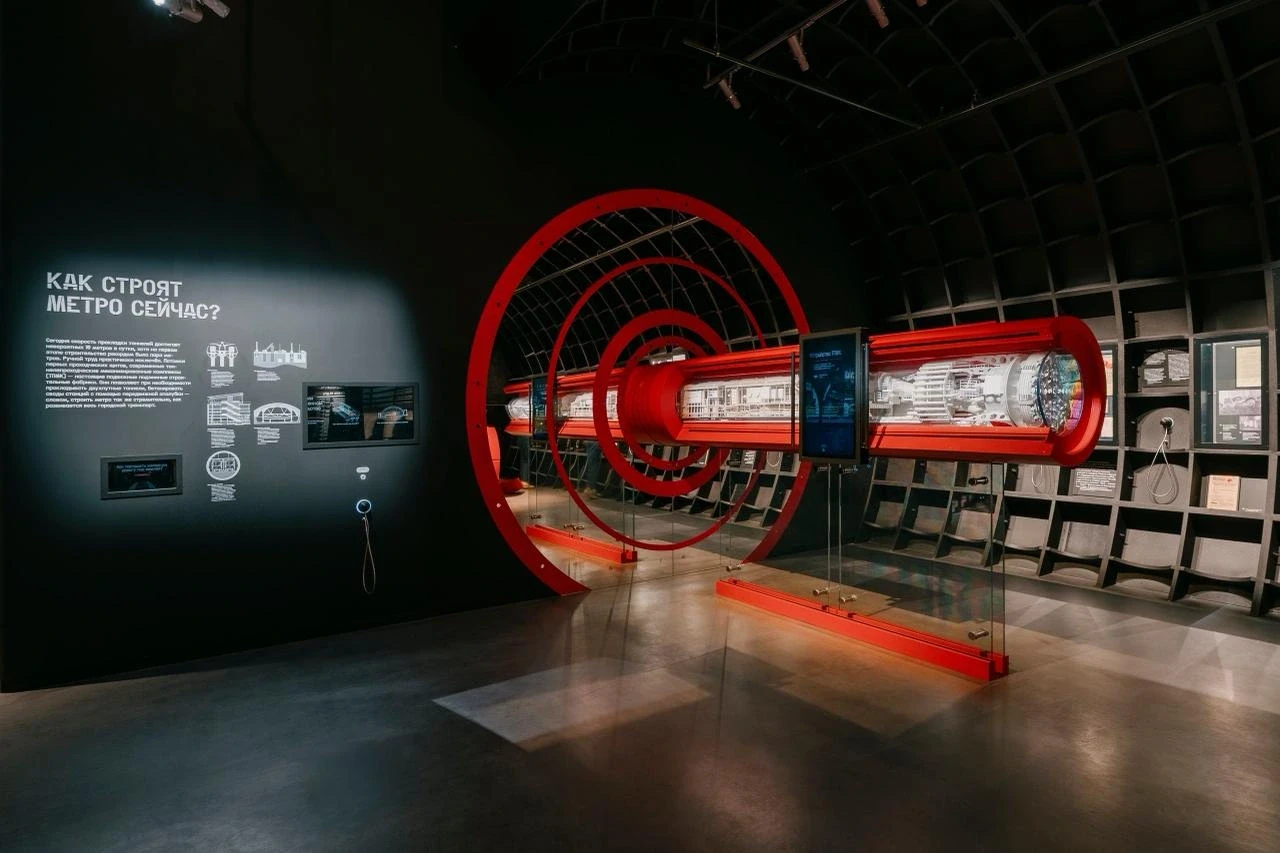
Two exhibition worlds — surface transport and the underground Metro — had to form a coherent experience. Under the exhibition design concept developed by Planet 9 studio, the ground floor follows the evolution of surface transport against the backdrop of revolution, industrialisation, war, post-war expansion and the changes of the 1990s. The underground exhibition reveals the Metro as a system of architecture, engineering, operations and human expertise.
Melnikov’s historic design and the building’s heritage restrictions imposed significant spatial and technical constraints. The Metro exhibition required an entirely new underground level, including the formidable task of lowering full-size metro cars through an installation opening more than 22 metres long.
There was also a wider institutional challenge. Even an exceptional permanent exhibition cannot, by itself, sustain public engagement. To become an enduring part of the city’s cultural life, the museum needed compelling reasons for people to return — and not just once, but regularly.


THE APPROACH
The conceptual response had two interconnected dimensions.
First, to create not simply a museum of transport, but a museum of the city told through transport.
Rather than focusing exclusively on vehicles, engineering and technological chronology, we used transport as a lens through which to explore Moscow’s growth, architecture, economy, social history, everyday life and future development. Historic vehicles became witnesses to social change, while multimedia environments revealed the people, decisions and technologies behind the city’s movement.
Second, to rethink the museum’s role as a cultural institution.
Oksana Bondarenko, Director of the Moscow Transport Museum and formerly a seasoned art manager and Director of the Tretyakov Gallery Foundation, brought an ambitious artistic vision to the project: what she envisaged as the world’s first repertory museum, operating more like a repertory theatre than a conventional museum.
The principle is simple: the collection gives people a reason to discover the museum; the changing cultural programme gives them a reason to return. In this model, the permanent exhibition is the foundation, while an evolving repertoire of cultural events, temporary exhibitions, artistic interventions, performances and educational activities becomes indispensable to the experience. These are not supplementary attractions, but integral to the museum’s identity and visitor proposition.
Drawing on international practice, we worked from the outset towards a hybrid institution: part technical museum, part cultural centre, part educational platform and part public gathering place. Transport becomes an accessible starting point for conversations about design, technology, art, urban life and the future of cities.
The multimedia experience was designed to turn visitors from observers into participants.
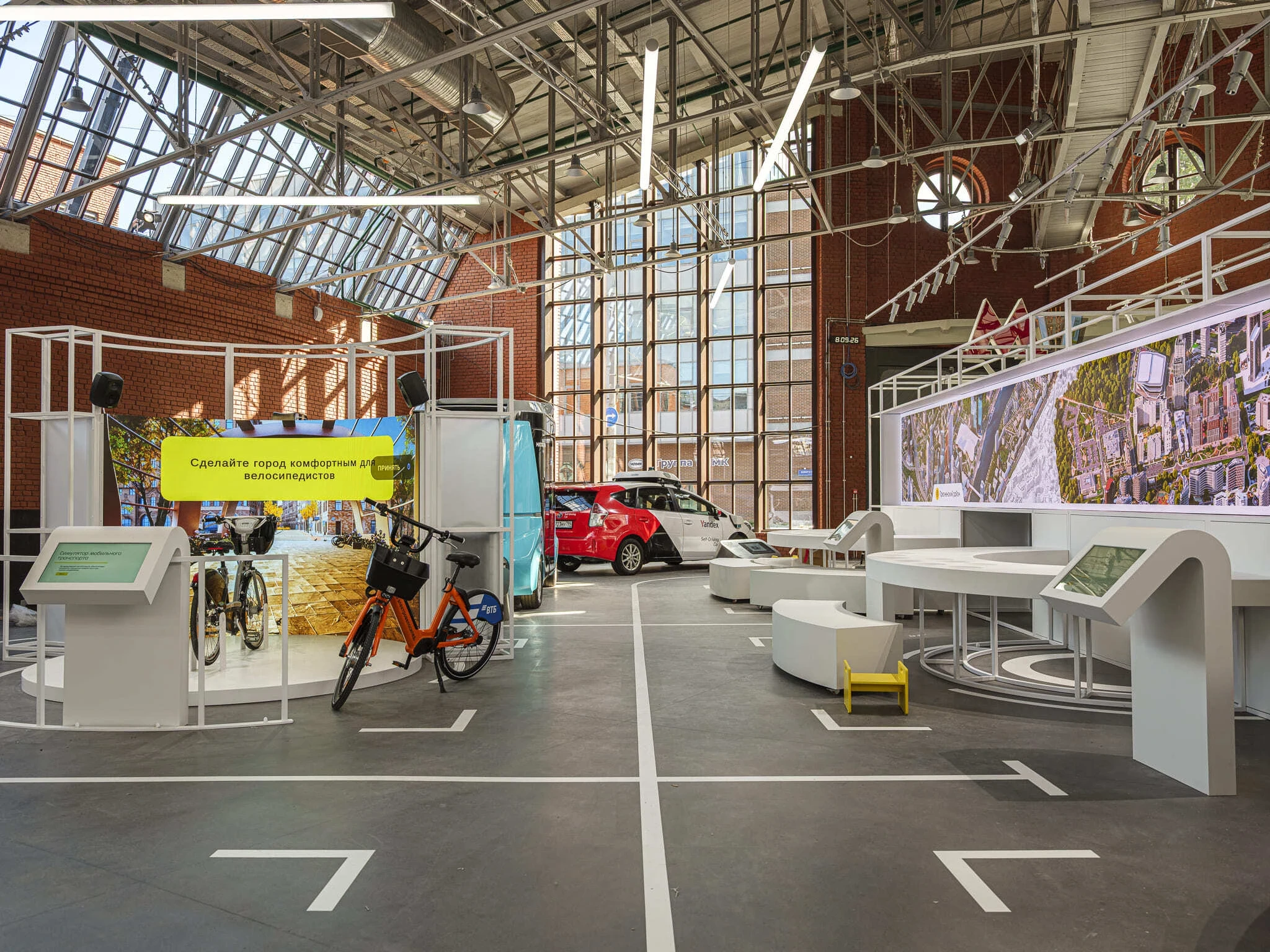
Across the permanent exhibition, 94 interactive installations and 27 simulators invite exploration through action and discovery. Visitors can experience the city through passengers’ memories, take the controls of a metro train, operate the Metro’s unified dispatch centre, drive a tram through a future Moscow, ride a Leyland bus through the twentieth-century city or assemble the engine of a Moskvich-412. The underground experience also reveals the Metro through the eyes of drivers, dispatchers, architects, engineers and maintenance workers, illuminating the infrastructure and expertise passengers rarely see. Each of the seven metro cars on display becomes an installation in its own right, from a 1927 Berlin-built car to a shadow theatre inside a maintenance railcar.
A location-aware multimedia guide offers four thematic routes, allowing visitors to explore according to their interests. A dedicated children’s route runs through the galleries, with interactive stops and tasks that allow younger visitors to engage independently. A technical archive, library, children’s centre and engineering school extend the experience through workshops, courses and programmes for children aged 7–14. Accessibility is supported by 77 tactile models, Braille labelling and a dedicated audio route for blind and visually impaired visitors.
Together, original objects, historical narratives, multimedia environments and hands-on activities form a coherent visitor journey in which learning and participation are part of the museum’s everyday life.
THE RESULT
Opened in October 2026, the Moscow Transport Museum’s permanent exhibition presents an extraordinary collection of urban transport heritage within a restored landmark of the Russian avant-garde. In architectural significance, exhibition scale and collection, it stands alongside the world’s leading transport museums.
Occupying approximately 9,318 m² across two floors and 13 thematic zones, the exhibition features 53 historic vehicles — including 3 that are the only surviving examples of their kind worldwide — more than 500 historical artefacts and over 220 models. Its multimedia infrastructure includes 94 interactive installations out of 268 in total, 27 simulators and 946 media content elements, combining historic collections with immersive storytelling, original technological development and participatory experiences.
The ground floor traces surface transport from the horse-drawn tram of 1872 to contemporary self-driving vehicles. The new underground level explores the history, architecture, engineering and operations of the Moscow Metro, combining original rolling stock with immersive installations that reveal the complex systems hidden from passengers.
Beyond the permanent exhibition, dedicated learning environments, children’s engineering programmes and a changing calendar of cultural activities lay the foundations for the repertory museum model envisioned at the conceptual stage: an institution conceived not as a static display of machines, but as a living cultural destination.
The project shows how a major historical collection, a remarkable architectural landmark, contemporary multimedia interpretation, original technological development and an ambitious cultural vision can come together to create a museum that uses transport to explore the past, present and future of one of the world’s great cities.
Photographs: courtesy of Museum of Moscow Transport and Pitch